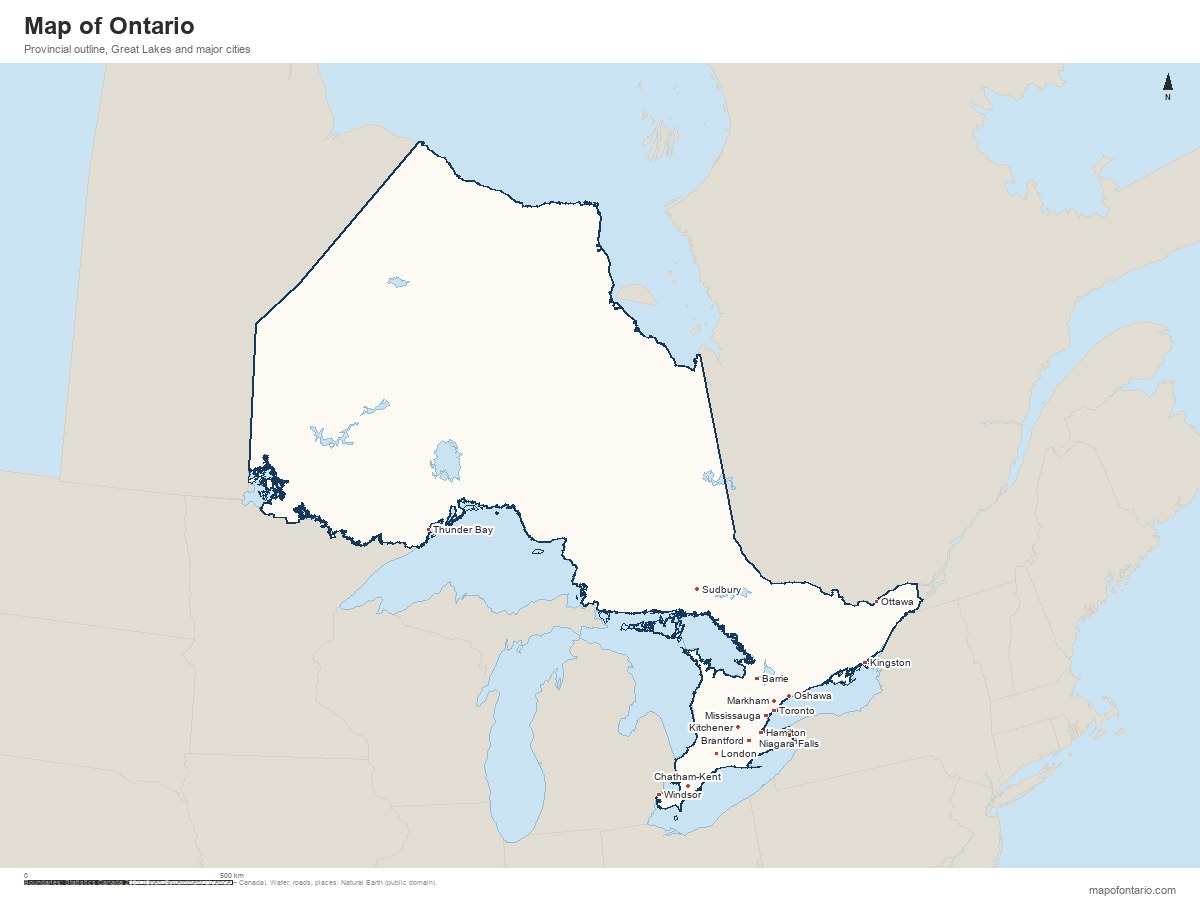
Major provincial parks, coloured by classification. Tap a pin for the park type and a short note.
An overview of Ontario's provincial parks system — how it's organized, where the parks are, and how to use this page to plan a visit.
Last reviewed on April 27, 2026
Major provincial parks, coloured by classification. Tap a pin for the park type and a short note.
Ontario manages one of the largest park systems in Canada. The provincial parks are administered by Ontario Parks, an agency of the provincial Ministry of the Environment, Conservation and Parks. The system protects more than 9 million hectares of land — roughly the size of Portugal — distributed across hundreds of individual parks. Some are world-famous destinations such as Algonquin Provincial Park; many others are small, lightly developed reserves used mostly for ecological protection rather than tourism.
Parks are concentrated in two broad bands. The first follows the cottage-country belt of central Ontario, where the Canadian Shield begins and the population centres of southern Ontario give way to lakes and forest. The second covers the far north, where vast wilderness parks protect boreal forest and Hudson Bay lowlands that are largely unreachable by road.
Each provincial park is assigned a classification that determines what kinds of activities it supports and how heavily it is developed. Understanding the classifications is the fastest way to find a park that fits your trip.
| Classification | Purpose | What you can typically do |
|---|---|---|
| Wilderness | Protect large, undisturbed natural areas | Backcountry camping, canoeing, hiking. No roads or facilities inside the park. Permits required. |
| Natural Environment | Combine ecological protection with recreation | Mix of front-country and backcountry. Car camping, canoe trips, hiking, swimming. Algonquin is the best-known example. |
| Recreation | Provide outdoor recreation opportunities close to where people live | Beaches, picnicking, day-use areas, family campgrounds. Often near population centres. |
| Waterway | Protect rivers and shoreline corridors | Canoeing and kayaking the protected waterway, with limited access points. |
| Nature Reserve | Strictly protect rare ecosystems and species | Day-use only or no public access; education and research focus. |
If you're planning a typical Ontario camping trip with a tent, your campsite is almost certainly in a Natural Environment or Recreation class park. If you want true backcountry, you're looking at Wilderness or the backcountry zones of larger Natural Environment parks.
Northern Ontario contains the largest parks by area, including some of the largest protected areas in North America. Wilderness-class parks such as Wabakimi, Woodland Caribou, Polar Bear, and Quetico cover enormous tracts of boreal forest, peatlands, and Hudson Bay coastline. Polar Bear Provincial Park is famously remote — there are no roads, and access is generally by aircraft only. Pukaskwa National Park (federally administered, not a provincial park) sits between these provincial parks along Lake Superior. For broader regional context, see the Northern Ontario regional map.
This is where most Ontarians take their first park trip. Algonquin Provincial Park is the largest and most-visited park in this region; it sits between Highway 60 to the south and the Ottawa Valley to the east. Other major parks in the central belt include Killarney (famed for the white quartzite La Cloche Mountains), Killbear on Georgian Bay, French River, the Massasauga, and Arrowhead near Huntsville. The Central Ontario map shows the geography this region covers, including Muskoka.
Southern Ontario's parks are smaller but easier to reach. Pinery, Sandbanks, Presqu'ile, and Rondeau provide Lake Erie and Lake Ontario beach destinations. Bronte Creek, Darlington, and Sibbald Point are within an easy drive of the Greater Toronto Area. Bruce Peninsula National Park (federal) and Cyprus Lake (provincial) form a popular pairing on the Bruce Peninsula. The Southern Ontario map shows the broader area.
The eastern parks are anchored by Frontenac, Charleston Lake, and Murphys Point along the Frontenac Arch. Bon Echo, with its dramatic 1.5 km cliff face on Mazinaw Lake, is one of the most photogenic parks in the province. Sandbanks Provincial Park in Prince Edward County is one of Ontario's busiest beach parks. The Eastern Ontario map covers the region.
A useful distinction: operating parks have staff, facilities, and a defined visitor season; non-operating parks do not. Most well-known parks are operating parks (Algonquin, Killarney, Sandbanks, Bon Echo, Pinery, Killbear, Arrowhead, etc.). Many smaller reserves are non-operating, meaning you can typically still visit on foot or by canoe, but there is no entrance station, no fees collected on site, and no maintained campsites.
For trip planning, focus on operating parks unless you specifically want a remote, no-services experience. The official Ontario Parks reservation system handles bookings for operating parks, with the booking window opening five months in advance — busy parks book up within minutes for peak weekends.
Parks are not the only protected outdoor spaces in Ontario. Conservation areas, run by 36 regional Conservation Authorities, also offer hiking, camping, and day-use facilities. Conservation areas tend to be smaller and closer to population centres than provincial parks. They're often the best option in the agricultural southwestern Ontario, where there are few provincial parks. Conservation areas have separate fees, hours, and reservation systems from Ontario Parks.
Ontario has more than 330 provincial parks, plus several hundred conservation reserves. Only about 120 are "operating" parks with staff, gates and facilities; the rest are non-operating areas managed mainly for conservation.
Polar Bear Provincial Park, on the Hudson Bay and James Bay coast, is by far the largest at over 23,000 square kilometres. It is roadless and reached only by aircraft. Among parks you can drive to, Algonquin is the best known at about 7,600 square kilometres.
Within about two hours of the GTA you can reach Sibbald Point, Bronte Creek, Darlington, Earl Rowe and Mara. A little further out are Algonquin's west gate, Killbear, Sandbanks, Pinery and Bon Echo.
For camping at operating parks, yes - reservations open five months ahead through the Ontario Parks system and popular summer weekends sell out within minutes. Day-use visits usually don't need a reservation, but vehicles need a day-use permit during the operating season; a few of the busiest parks now require day-use bookings on peak days.