Eastern Ontario Map
Regional map with Ottawa, Kingston, and the St. Lawrence corridor.
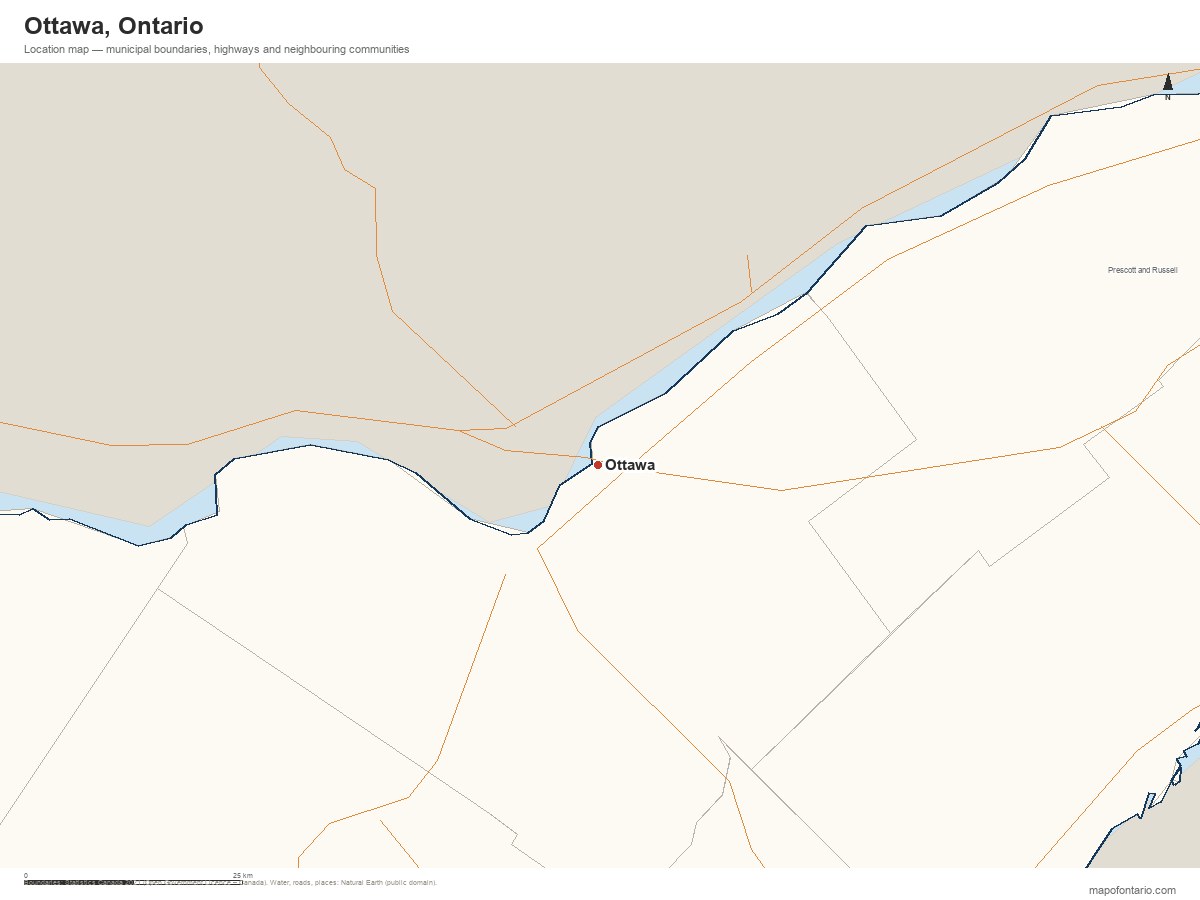
Map of Ottawa, Canada's national capital, located in Eastern Ontario at the junction of the Ottawa, Rideau, and Gatineau rivers. The city sits on the Ontario–Quebec border across from Gatineau.
Last reviewed on April 27, 2026
Ottawa is the capital of Canada and the second-largest city in Ontario. It is the seat of the federal Parliament, the Supreme Court, and most government departments. Major institutions include the National Gallery of Canada, the Canadian Museum of History (across the river in Gatineau), the National Arts Centre, and the Rideau Canal, a UNESCO World Heritage Site that becomes the world's largest skating rink each winter.
The city straddles the Ottawa River and includes a mix of urban core, suburbs, and rural belt. Major highways include Highway 417 (the Queensway), which crosses the city east-west, and Highway 416 connecting south toward the 401. The Macdonald-Cartier International Airport serves the region. Bilingualism is woven into the city's character due to its position adjacent to French-speaking Quebec.
Notable areas include Centretown and the ByWard Market downtown, the Glebe and Old Ottawa South for residential and shopping, Sandy Hill near the University of Ottawa, Westboro for restaurants, and Kanata as a major technology employment node. Outlying communities include Orleans, Barrhaven, Stittsville, and the rural villages absorbed by amalgamation in 2001.
Ottawa is part of Eastern Ontario, with a population of approximately 1 million. For broader context, see the Eastern Ontario regional map and the Ontario map with cities.
| Region | Eastern Ontario |
| Census division | Ottawa |
| Population (2021 census) | 1,017,449 |
| Coordinates | 45.4215° N, 75.6972° W |
Ottawa sits where the Rideau River and Rideau Canal meet the Ottawa River, which forms the boundary with Quebec. Parliament Hill and the downtown core sit on the south bank; Gatineau, Quebec is directly across the water and appears at the top of most Ottawa maps. The 2001 amalgamation made the city unusually large in area, so a great deal of what the map covers is farmland and village rather than built-up city.
Highway 417, known locally as the Queensway, is the east–west spine through the middle of the city. Highway 416 runs south to meet the 401 near Prescott, which is the usual route to and from Toronto. Ottawa Road 174 carries traffic east toward Orléans. The O-Train light rail follows the Queensway corridor through the centre.
Straight-line distances from Ottawa to other communities covered on this site. Road distances will be longer.
| Community | Distance |
|---|---|
| Smiths Falls | 63 km |
| Cornwall | 88 km |
| Brockville | 93 km |
| Pembroke | 118 km |
| Petawawa | 134 km |
| Kingston | 146 km |
The printable map on this page is drawn from Statistics Canada 2021 census boundary files and Natural Earth water and road data. It shows the municipal boundaries around Ottawa, neighbouring communities, major highways, and lakes and rivers, with a scale bar for distance. The interactive map above it can be zoomed and panned; the PDF version is sized for letter paper.
Ottawa is in Ontario. It sits on the south bank of the Ottawa River; the city of Gatineau, directly across the river, is in Quebec.
Ottawa is the largest city in Eastern Ontario, the region running from the Kingston area northeast along the St. Lawrence and Ottawa rivers.
By road it is roughly 450 km via Highway 401 and Highway 416, usually about four and a half hours of driving.
Other useful maps for trips through this part of Ontario
Regional map with Ottawa, Kingston, and the St. Lawrence corridor.
Complete provincial highway network including the 400-series.
All major Ontario cities and towns on a single map.
Full directory of city and town maps across the province.