Northern Ontario Map
Regional map covering the northwest including Thunder Bay and Kenora.
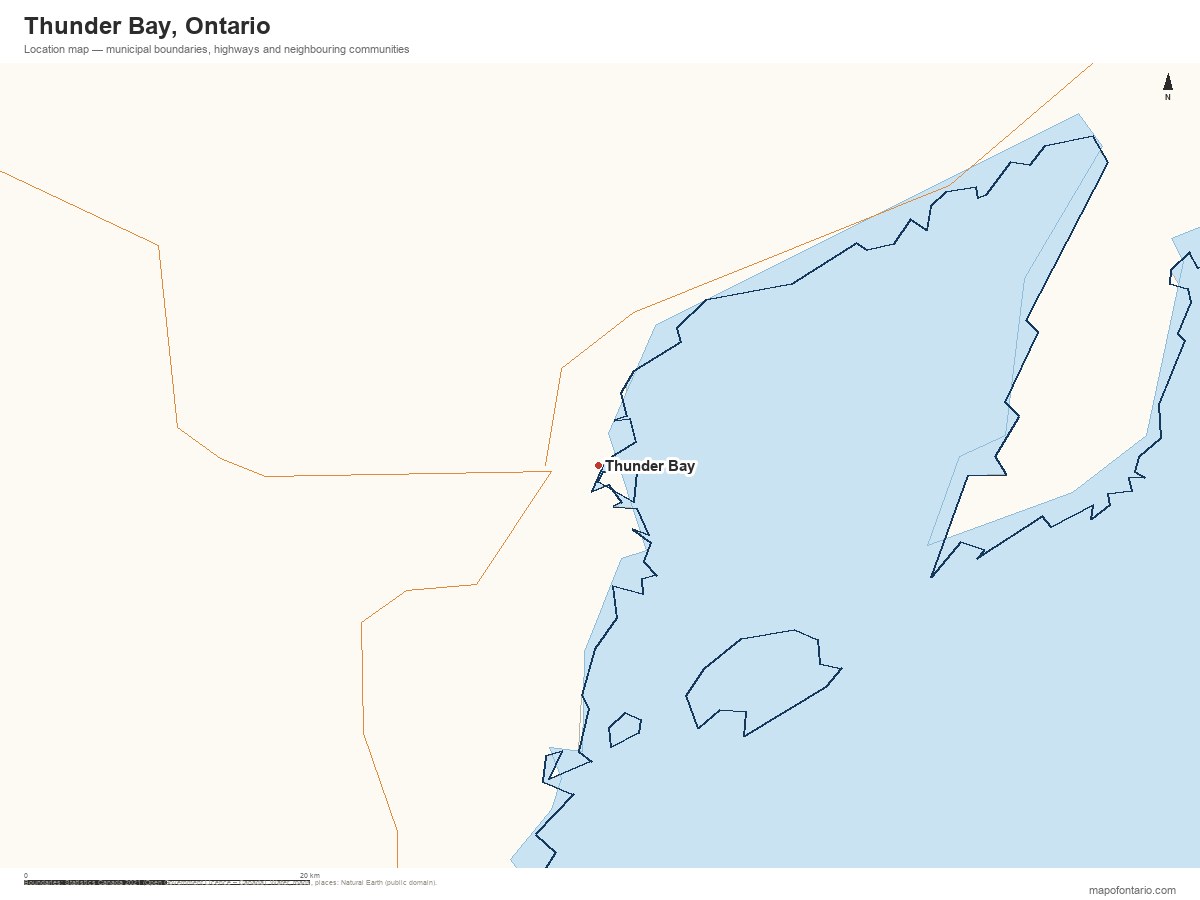
Map of Thunder Bay, the largest city in northwestern Ontario, situated at the head of Lake Superior at the mouth of the Kaministiquia River.
Last reviewed on April 27, 2026
Thunder Bay is the regional centre for Northwestern Ontario, a major Great Lakes port handling grain and other bulk cargo, and a hub for forestry and education. The city was formed in 1970 from the merger of Port Arthur and Fort William, and the two former downtowns still function as distinct urban cores.
Major routes include Highway 11/17 (Trans-Canada) which curves around the city. The Sleeping Giant peninsula across the bay is one of Ontario's iconic landmarks. Kakabeka Falls, the second-tallest waterfall in Ontario, lies to the west.
The Port Arthur core (north end) around Cumberland and Red River Road, the Fort William core (south end) around Victoria Avenue, Bay/Algoma, Westfort, and the Intercity commercial district between the two downtowns are the city’s main areas.
Thunder Bay is part of Northwestern Ontario, with a population of approximately 110,000. For broader context, see the Northern Ontario regional map and the Ontario map with cities.
| Region | Northern Ontario |
| Census division | Thunder Bay |
| Population (2021 census) | 108,843 |
| Coordinates | 48.3809° N, 89.2477° W |
Thunder Bay sits at the northwestern head of Lake Superior, where the Kaministiquia River enters the lake. The city was created in 1970 by merging Port Arthur in the north and Fort William in the south, which is why the map shows two distinct downtown cores rather than one. The Sleeping Giant peninsula lies across the bay to the east and is visible from most of the waterfront.
Highway 11 and Highway 17 — both carrying the Trans-Canada Highway — meet in the Thunder Bay area, making the city the main road junction of northwestern Ontario. Highway 61 runs south to the Pigeon River crossing into Minnesota. Distances here are unlike southern Ontario: the nearest Ontario cities of comparable size are several hundred kilometres away.
Straight-line distances from Thunder Bay to other communities covered on this site. Road distances will be longer.
| Community | Distance |
|---|---|
| Kenora | 412 km |
| Sault Ste. Marie | 422 km |
| Elliot Lake | 544 km |
| Timmins | 584 km |
| Sudbury | 655 km |
| Kirkland Lake | 682 km |
The printable map on this page is drawn from Statistics Canada 2021 census boundary files and Natural Earth water and road data. It shows the municipal boundaries around Thunder Bay, neighbouring communities, major highways, and lakes and rivers, with a scale bar for distance. The interactive map above it can be zoomed and panned; the PDF version is sized for letter paper.
The city was formed in 1970 from the amalgamation of Port Arthur and Fort William, two separate cities that each had their own commercial core. Both survive today.
Eastern Time, like most of Ontario. The Central Time zone begins further west, near the Manitoba side of the province.
Roughly 1,400 km by road — about 15 hours of driving, or a two-hour flight.
Other useful maps for trips through this part of Ontario
Regional map covering the northwest including Thunder Bay and Kenora.
Complete provincial highway network including the 400-series.
All major Ontario cities and towns on a single map.
Full directory of city and town maps across the province.