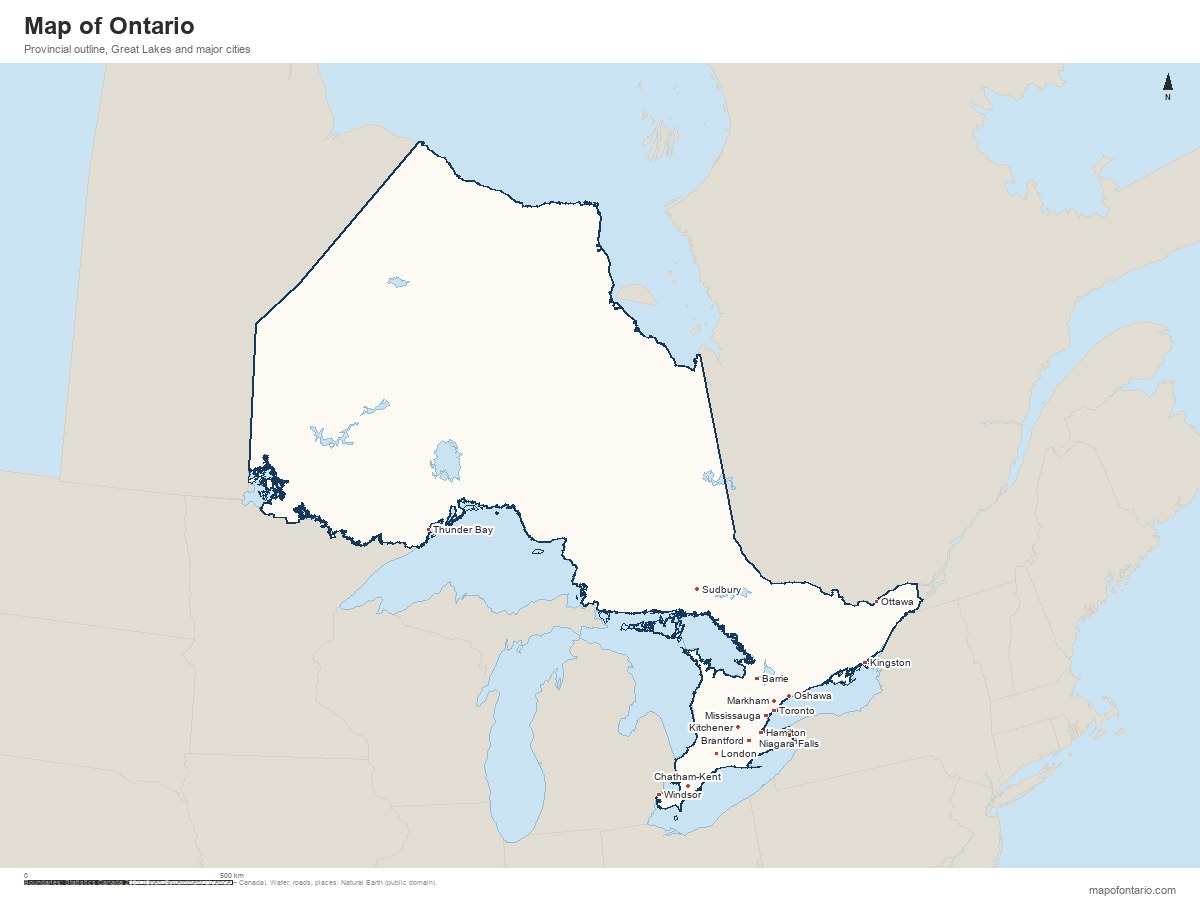
Blue pins observe Eastern Time; orange pins observe Central Time. Tap a pin for details. Crossing the border? Compare with the US time zones map.
Ontario sits across two time zones. Most of the province runs on Eastern Time, but a strip in the far northwest runs on Central Time. Here is where the line falls and what it means in practice.
Last reviewed on April 27, 2026
Blue pins observe Eastern Time; orange pins observe Central Time. Tap a pin for details. Crossing the border? Compare with the US time zones map.
Ontario is divided into two standard time zones:
| Zone | Standard time | Daylight time | Where it applies in Ontario |
|---|---|---|---|
| Eastern Time | EST (UTC−5) | EDT (UTC−4) | The vast majority of the province, including Toronto, Ottawa, Hamilton, London, Sudbury, Thunder Bay, and Sault Ste. Marie |
| Central Time | CST (UTC−6) | CDT (UTC−5) | A small area in the far northwest along the Manitoba border, including Atikokan, Pickle Lake, and parts of the Rainy River District |
Most travellers will only deal with Eastern Time in Ontario. Central Time only matters if you are crossing into Manitoba or visiting one of the small communities near the Ontario–Manitoba border.
The Eastern–Central time zone line in Ontario does not follow the Manitoba border or any single line of longitude. It zigzags across the northwest, reflecting historical decisions made by individual communities and townships.
The general pattern: Thunder Bay — despite being well west of Toronto — observes Eastern Time, and so does most of the Thunder Bay District around it. As you move further west toward the Manitoba border, you cross into Central Time. Kenora and most of the Kenora District use Central Time. Atikokan, Rainy River, Fort Frances, and the rest of the Rainy River District also use Central Time, with one notable exception: Atikokan and Pickle Lake do not observe daylight saving and stay on Eastern Standard Time year-round, putting them on the same clock as Central Daylight Time in summer and one hour ahead of Central Standard Time in winter.
The shift creates situations that surprise first-time visitors. Drive Highway 17 west from Thunder Bay and you do not change time at any clearly marked sign — the boundary is municipal, not geographic. Most modern phones pick the change up automatically through GPS, but car clocks and watches do not.
Most of Ontario observes daylight saving time. Clocks spring forward by one hour on the second Sunday of March and fall back on the first Sunday of November. This is the same schedule as the United States and most of Canada. Ontario passed legislation in 2020 to move permanently to daylight time, but the change is conditional on Quebec and New York State doing the same; until then, the switch continues twice a year.
Two notable exceptions stay on standard time year-round:
The boundary reflects population and history more than geography. Ontario's south and east have always looked toward Toronto, Montreal, and the US Northeast for trade and communication, all on Eastern Time. The northwest, by contrast, is closer to Winnipeg than to Toronto, and railways, broadcasting, and commerce in that corner have historically tied the area to Manitoba. Communities in the Rainy River and Kenora districts adopted Central Time because that is what their economic neighbours used.
If you are driving Highway 11 or Highway 17 across northwestern Ontario, plan for a one-hour change somewhere between Thunder Bay and Manitoba. Because the boundary is municipal rather than fixed, the change appears at different points depending on the route — check your destination's local time before you arrive.
Air travel within Ontario almost always uses Eastern Time on schedules, even on flights into Kenora or other Central-Time communities — airlines display departure and arrival times in the local time of each airport, so a flight that "leaves Toronto at 8:00 and arrives in Kenora at 10:00" represents a four-hour trip, not two. Always check whether posted times are local at each end.
Calls between Toronto and Kenora cross one hour. Calls from Toronto to Winnipeg, Manitoba cross the same hour. Toronto to New York City, despite being further apart, is the same time zone.
Ontario shares borders with Quebec, Manitoba, and five US states (Minnesota, Michigan, Ohio, Pennsylvania and New York — the last three across the water of the Great Lakes). Time-zone comparisons:
For the United States more broadly, the country uses six standard time zones (and several non-standard ones for territories). If you are planning a cross-border road trip, the US time zones map shows where each zone falls and which states observe daylight saving.
Yes. Toronto, the rest of southern Ontario, the Greater Toronto Area, Ottawa, and almost all of the populated north use Eastern Time year-round (with the daylight-saving switch in March and November).
Eastern Time. Despite being further west than many Central-Time cities in Manitoba, Thunder Bay observes Eastern Time, putting local clocks one hour ahead of Winnipeg.
Most of Ontario does. Atikokan and Pickle Lake in the northwest do not. The provincial government passed legislation to keep daylight time year-round, but it depends on Quebec and New York joining; until they do, the seasonal change continues.
Because of historical commercial ties to Winnipeg, Manitoba. Kenora and the surrounding Kenora District operate on Central Time, like the rest of the prairies.
Eastern Time. Algonquin Provincial Park sits well within the Eastern-Time portion of the province.