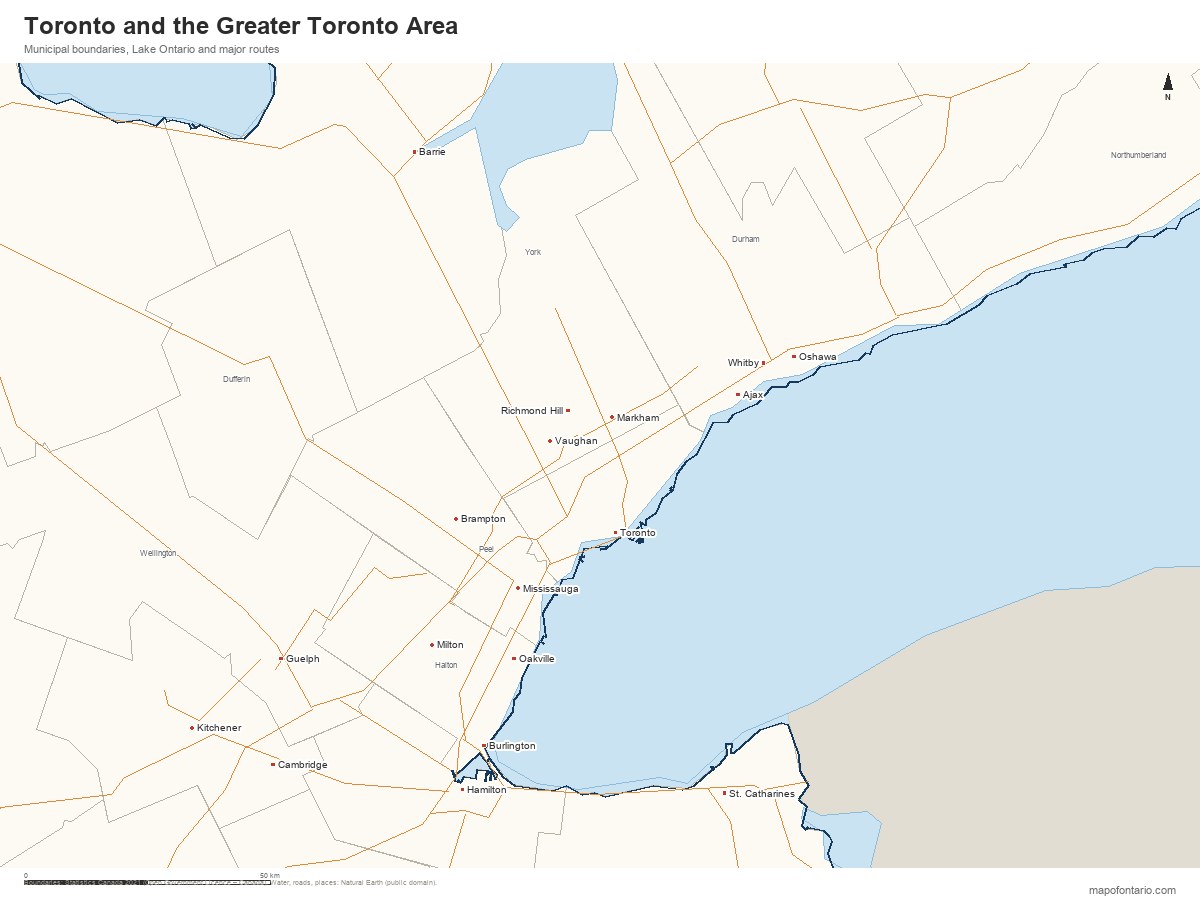
Southern Ontario Map
Complete map of Southern Ontario including the GTA region.
Last reviewed on April 27, 2026
Interactive and printable map of Toronto, Ontario's capital and Canada's largest city. Explore neighborhoods, major streets, landmarks, and points of interest in this vibrant metropolitan area of 2.9 million people.
Toronto is Ontario's provincial capital and Canada's most populous city, home to approximately 2.9 million residents. Located on the northwestern shore of Lake Ontario, Toronto serves as the economic and cultural heart of the Greater Toronto Area (GTA), which comprises over 6 million people.
The city is renowned for its diverse neighborhoods, including the financial district downtown, the historic Distillery District, multicultural areas like Kensington Market and Chinatown, and waterfront communities along Lake Ontario. Major landmarks include the CN Tower, Rogers Centre, Royal Ontario Museum, and the Toronto Islands.
Toronto's economy is driven by finance, technology, film production, and tourism. The city is served by an extensive public transit network including the TTC subway system, streetcars, and buses. Major highways include the Gardiner Expressway, Don Valley Parkway (DVP), and Highway 401, which runs along the northern boundary of the city. Toronto Pearson International Airport, located in nearby Mississauga, is Canada's busiest airport and a major international hub.
Toronto is divided into numerous distinct neighborhoods, each with its own character. Downtown Toronto includes the Financial District, Entertainment District, and St. Lawrence Market. The Annex, Yorkville, and Rosedale offer upscale residential areas, while Queen West, Leslieville, and the Beaches provide trendy shopping and dining experiences. Scarborough, North York, and Etobicoke represent the city's former suburbs, amalgamated into the City of Toronto in 1998.
| Area | Where | Known for |
|---|---|---|
| Financial & Entertainment District | Downtown core | Bank towers, CN Tower, Rogers Centre, theatres |
| Old Town / St. Lawrence | East of downtown | St. Lawrence Market, the Distillery District |
| Yorkville & The Annex | Midtown / north of Bloor | Luxury shopping, the ROM, the University of Toronto |
| Kensington & Chinatown | West of downtown | Independent shops, multicultural food |
| Queen West & Leslieville | West and east ends | Galleries, cafes, design shops |
| The Beaches | East end on the lake | Boardwalk, sandy beaches, Woodbine Park |
| Scarborough, North York, Etobicoke | Outer city | Residential suburbs, the Scarborough Bluffs, Ontario Science Centre |
The TTC runs the subway, streetcars and buses; its two main subway lines (Line 1 in a U-shape through downtown and Line 2 east-west along Bloor-Danforth) cover most visitor destinations. GO Transit trains and buses link Toronto with the wider Greater Toronto Area and beyond - including a service to Niagara Falls. Drivers use the Gardiner Expressway along the waterfront, the Don Valley Parkway (DVP) on the east side, and Highway 401 across the top of the city - one of North America's busiest highways. Toronto Pearson International Airport (YYZ), Canada's busiest, sits just west of the city in Mississauga and connects to Union Station by the UP Express train in about 25 minutes.
Toronto sits in Southern Ontario, on the northwest shore of Lake Ontario, at the centre of the Greater Toronto Area and the wider Golden Horseshoe.
Yes. Toronto is the provincial capital of Ontario and the largest city in Canada, with about 2.9 million people in the city and over 6 million across the GTA. (Canada's national capital is Ottawa.)
It is about 130 km - roughly 1.5 hours by car on the QEW, or about 2.5 hours by GO Train plus the WEGO bus. See our directions to Niagara Falls guide.
| Region | Central Ontario |
| Census division | Toronto |
| Population (2021 census) | 2,794,356 |
| Coordinates | 43.6532° N, 79.3832° W |
Toronto is laid out on a street grid that makes the map easy to read once you find two reference lines. Yonge Street runs north from the harbour and splits the city into east and west — every cross street changes its address direction there. The lakeshore forms the southern edge, and the old shoreline of glacial Lake Iroquois creates the noticeable rise at Davenport Road and Casa Loma.
Highway 401 crosses the top of the city east to west and is the main through route; the Gardiner Expressway runs along the waterfront downtown, and the Don Valley Parkway connects the two through the river valley on the east side. Highway 427 serves the west end toward the airport and Highway 404 continues north from the DVP. The TTC subway follows Yonge and Bloor, which is why so many neighbourhood names on the map cluster along those two corridors.
Straight-line distances from Toronto to other communities covered on this site. Road distances will be longer.
| Community | Distance |
|---|---|
| Mississauga | 22 km |
| Vaughan | 22 km |
| Markham | 23 km |
| Richmond Hill | 26 km |
| Pickering | 31 km |
| Brampton | 32 km |
The printable map on this page is drawn from Statistics Canada 2021 census boundary files and Natural Earth water and road data. It shows the municipal boundaries around Toronto, neighbouring communities, major highways, and lakes and rivers, with a scale bar for distance. The interactive map above it can be zoomed and panned; the PDF version is sized for letter paper.
Explore more maps of Southern Ontario and nearby cities
Complete map of Southern Ontario including the GTA region.
Map of Mississauga, Toronto's western neighbor with 720K residents.
Detailed map of Brampton, fast-growing city north of Toronto.
Map of Markham, technology hub northeast of Toronto.
Complete highway network including Highway 401 and DVP.
Map showing all major cities across Ontario.