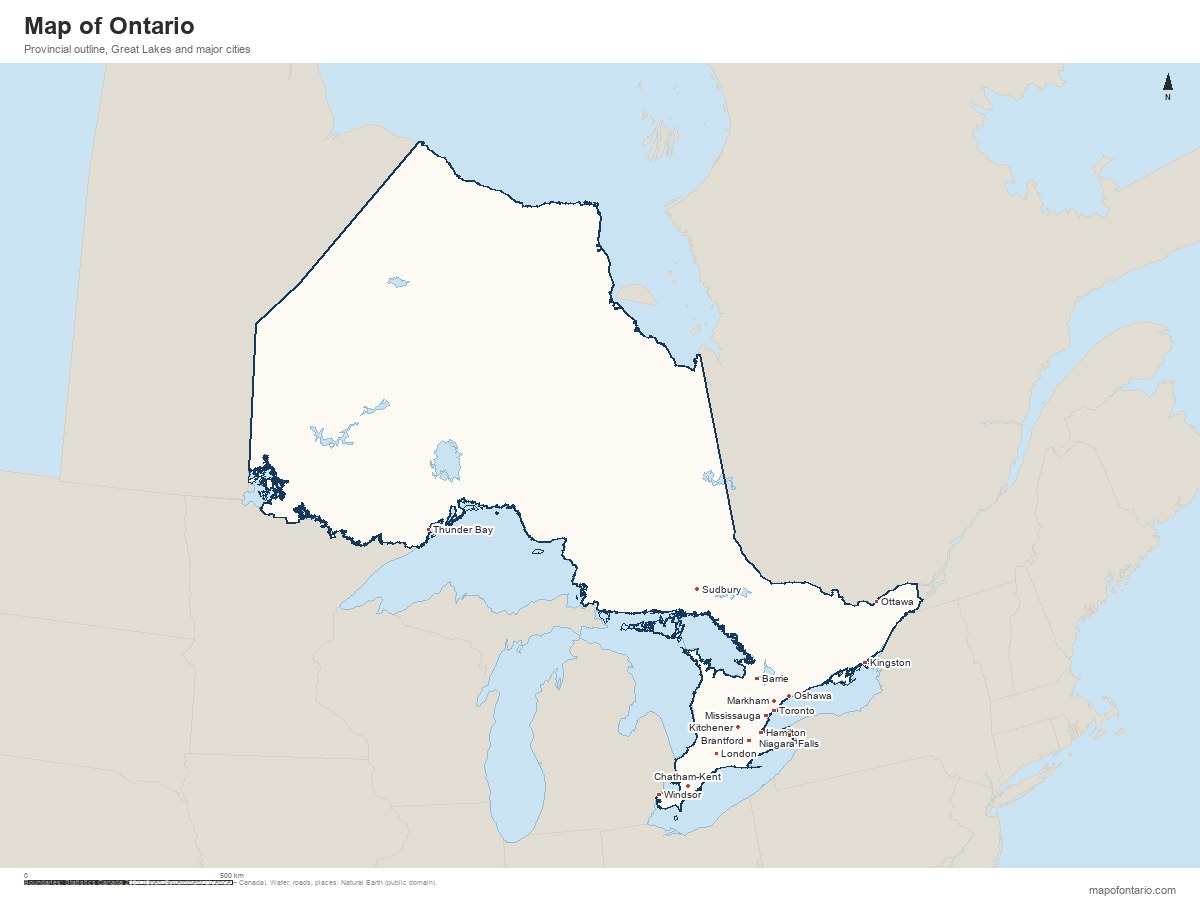
Where Ontario is and how big it is
Ontario is the second-largest of Canada's provinces, covering about 1,076,395 square kilometres - bigger than France and Spain combined. It stretches from the Great Lakes and the United States border in the south to the shores of Hudson Bay and James Bay in the north, and from the Ottawa River and Quebec in the east to Manitoba and the Lake of the Woods in the west. Despite its size, the great majority of Ontario's roughly 15 million people live in a narrow band in the far south, close to the lakes.
Water is everywhere: Ontario contains around a quarter of a million lakes - by some counts about one-fifth of the world's fresh water lies in and around the province - and roughly one-sixth of Ontario's own area is covered by water.
The three landform regions
Geographers divide Ontario into three physiographic (landform) regions. They are the single most important idea in Ontario's physical geography, because they explain where people live, where farming is possible, and where the forests, mines and wilderness are.
| Region | Where | Character |
|---|
| Canadian Shield |
Most of central and northern Ontario |
Ancient Precambrian rock, thin soils, endless lakes and boreal forest. Rich in minerals; poor for farming. Covers more than half the province. |
| Hudson Bay Lowlands |
The far north, along the Hudson Bay and James Bay coasts |
A flat, poorly drained plain of muskeg, peat bogs and wetlands - one of the largest wetlands on Earth. Very few people; no road access to most of it. |
| Great Lakes–St. Lawrence Lowlands |
Southern Ontario, around the lower Great Lakes |
Flat to gently rolling land with deep, fertile soils and a milder climate. The smallest region by area but home to most Ontarians, the best farmland and nearly all the big cities. |
The Canadian Shield
The Canadian Shield dominates Ontario. This horseshoe of some of the oldest rock on the planet sweeps down from the northwest, wraps around Hudson Bay, and reaches almost to Lake Ontario near Kingston. Glaciers scraped its soils thin and left behind the tens of thousands of lakes that define cottage country and the canoe-tripping parks. It is the source of Ontario's mining wealth - the nickel of Sudbury, the gold of Timmins and Kirkland Lake - and most of its forests and hydro power.
The Hudson Bay Lowlands
North of the Shield, the land flattens into the Hudson Bay Lowlands, a vast wetland sloping gently to the sea. It is cold, wet and almost roadless; communities such as Moosonee and the Cree coastal villages are reached by rail, air or water. Polar bears range its coast, and Polar Bear Provincial Park - Ontario's largest - protects part of it.
The Great Lakes–St. Lawrence Lowlands
The southern lowlands are small but mighty. Warmed by the surrounding lakes and blessed with deep glacial soils, this is where you find Southern Ontario's farmland, the vineyards of Niagara and Prince Edward County, and the great cities of the Golden Horseshoe - Toronto, Hamilton, the Niagara region - along with London, Windsor and Ottawa.
Highest and lowest points
Ontario is not a mountainous province. Its highest point, Ishpatina Ridge in the Temagami highlands of the northeast, reaches only about 693 metres (2,274 feet) - a modest summit on the Shield. The lowest point is sea level, along the saltwater coast of Hudson Bay and James Bay. The most dramatic relief most visitors see is the Niagara Escarpment, the long limestone cliff that runs from Niagara Falls up to the Bruce Peninsula and carries the Bruce Trail.
The Great Lakes and major waters
Four of the five Great Lakes border Ontario - Superior (the largest freshwater lake in the world by area), Huron, Erie and Ontario - and only Lake Michigan lies wholly in the United States. They drain east through the St. Lawrence River to the Atlantic. The largest lake lying entirely within the province is Lake Nipigon, north of Lake Superior. Other major inland lakes include Lake Simcoe, Lake Nipissing, Lac Seul and the sprawling Lake of the Woods on the Manitoba-Minnesota border. See the Great Lakes shoreline map for more.
Major rivers
Ontario's rivers fall into two great drainage systems. In the south, water flows toward the Great Lakes and the St. Lawrence; the Ottawa River forms the entire boundary with Quebec. In the north, big rivers such as the Albany, Moose, Severn, Attawapiskat and Winisk run the other way, draining the Shield and Lowlands north into Hudson Bay and James Bay.
Climate
Ontario spans a wide climate range. The far south has a humid continental climate moderated by the Great Lakes, giving it the province's mildest winters and longest growing season - long enough for Niagara's vineyards and orchards. Moving north, winters lengthen and deepen; the Hudson Bay coast is subarctic, with brief cool summers and long, severe winters. The lakes themselves shape local weather, producing heavy "lake-effect" snow in belts downwind of Lakes Huron and Superior. Most of the province also sits in the Eastern Time zone, with a small western strip on Central Time.
Common questions
What are the three landform regions of Ontario?
The Canadian Shield (most of the province), the Hudson Bay Lowlands (the far north) and the Great Lakes-St. Lawrence Lowlands (the populated south).
What is the highest point in Ontario?
Ishpatina Ridge, about 693 m (2,274 ft), in the northeast near Temagami. The lowest point is sea level on the Hudson Bay coast.
How big is Ontario?
About 1,076,395 km² including water - Canada's second-largest province after Quebec, and larger than any US state except Alaska.
Which Great Lakes border Ontario?
Superior, Huron, Erie and Ontario. Only Lake Michigan lies entirely within the United States.
Related maps