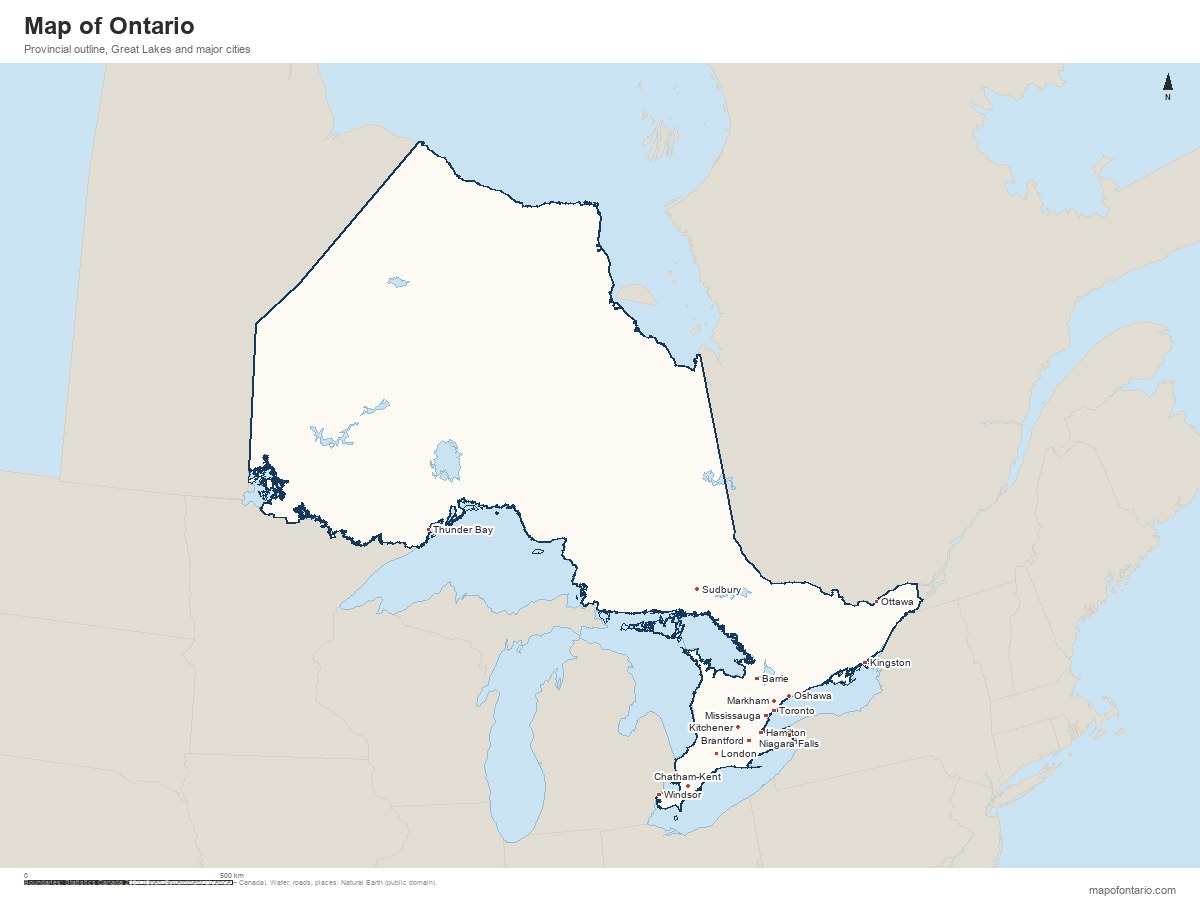
Blue pins mark lakes; teal pins mark rivers and waterways. Tap a pin for details.
Ontario is one of the most water-rich places on Earth. This interactive map shows the four Great Lakes that border the province, its largest inland lakes, and the major rivers and canals that thread through it.
Last reviewed on June 8, 2026
Blue pins mark lakes; teal pins mark rivers and waterways. Tap a pin for details.
Four of the five Great Lakes form Ontario's southern and western edge, holding about a fifth of the world's surface fresh water between them. They are the defining feature of the province's geography, climate and economy.
| Lake | Notes |
|---|---|
| Lake Superior | The largest freshwater lake in the world by area, and the deepest and coldest of the Great Lakes. Forms Ontario's northwest shore. |
| Lake Huron | Includes Georgian Bay and Manitoulin Island, the largest freshwater island on Earth. Famous for its beaches and shipwrecks. |
| Lake Erie | The shallowest and warmest Great Lake, on the south shore by Windsor and the Niagara region. Its warmth drives the Lake Erie snowbelt and the Niagara wine climate. |
| Lake Ontario | The easternmost and smallest by surface area, but very deep. Toronto, Hamilton and Kingston sit on its shore; it drains to the St. Lawrence. |
For the shoreline in detail, see the Great Lakes shoreline map.
Beyond the Great Lakes, Ontario contains around 250,000 lakes - more than any other comparable area in the world. The largest lying entirely within the province is Lake Nipigon, north of Lake Superior. Other notable inland lakes include:
Ontario's rivers split into two great drainage systems. Southern rivers flow toward the Great Lakes and the Atlantic; northern rivers flow the opposite way into Hudson Bay and James Bay.
Two famous canal routes turn Ontario's lakes and rivers into through-routes for boats:
A continental drainage divide crosses Ontario. South of it, water flows to the Great Lakes and the St. Lawrence and on to the Atlantic Ocean. North of it - across most of the province by area - water flows into Hudson Bay and James Bay, part of the Arctic watershed. The divide runs through the high ground of the Canadian Shield, which is why a few hours' drive north of Lake Superior can put you in country whose rivers never reach the Great Lakes at all.
Roughly 250,000 - more than any comparable area on Earth. With the Great Lakes, the province holds a large share of the planet's fresh surface water.
Lake Nipigon, north of Lake Superior. The Great Lakes are bigger but are shared with the United States.
In the south: the Ottawa, St. Lawrence, Niagara, Grand and Thames. In the north: the Albany, Moose, Severn, Attawapiskat and Winisk.
A 386 km canal route from Lake Ontario at Trenton to Georgian Bay at Port Severn, through the Kawartha Lakes - a National Historic Site and popular boating route.